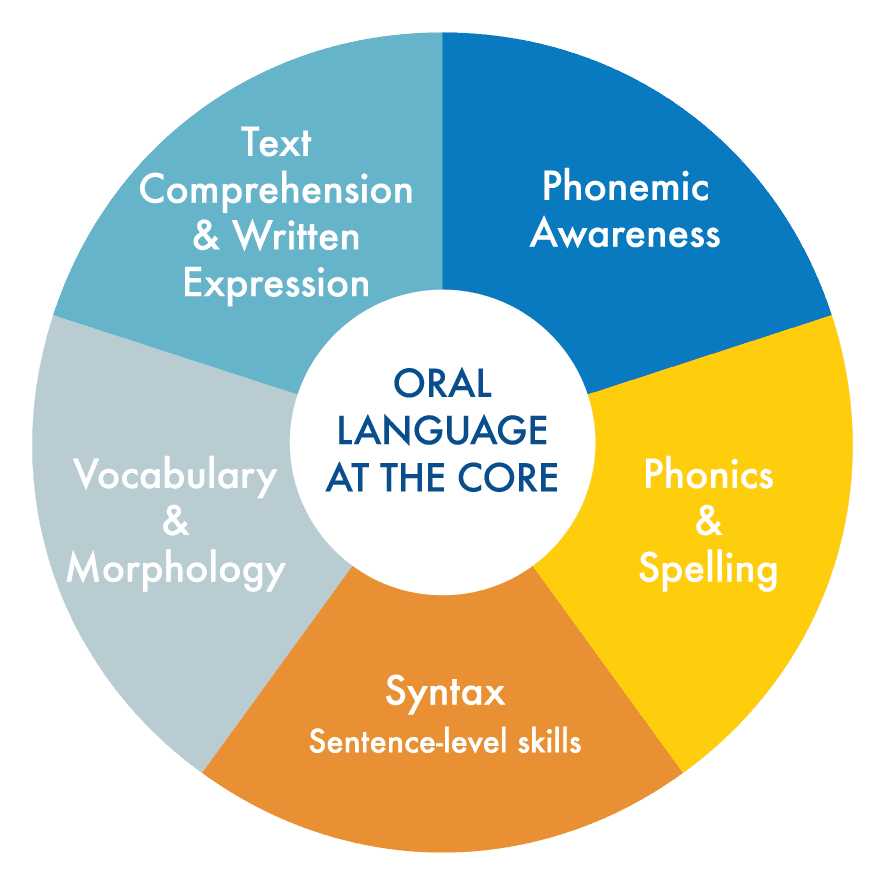
Oral language (OL), sometimes called spoken language, includes speaking and listening—the ways that humans communicate with one another. OL skills provide the foundation for word reading and comprehension. They are at the heart of listening and reading comprehension, serving as a predictor for both.
Oral language (OL), sometimes called spoken language, includes speaking and listening—the ways that humans communicate with one another. OL skills provide the foundation for word reading and comprehension. They are at the heart of listening and reading comprehension, serving as a predictor for both.
Academic Language, also referred as Academic or Standard English, is the language of the classroom and text. Students must have a command of Academic English in order to achieve in school. Teachers should be attuned to their own spoken language and model Academic English by creating spaces and providing opportunities where they would expect their students to use Academic English in both written and oral forms. With younger children, begin with explicit teaching and modeling. Show and Tell, and Circle Time are great places to expand sentences and provide models with Academic English. And keep in mind that all children–whether native English speakers or English Language Learners–receive the same practice and correction. For older children, consider starting with writing because the students have time to think about academic language, as well as time to revise. Then, after giving time to rehearse, ask students to make an oral presentation.
